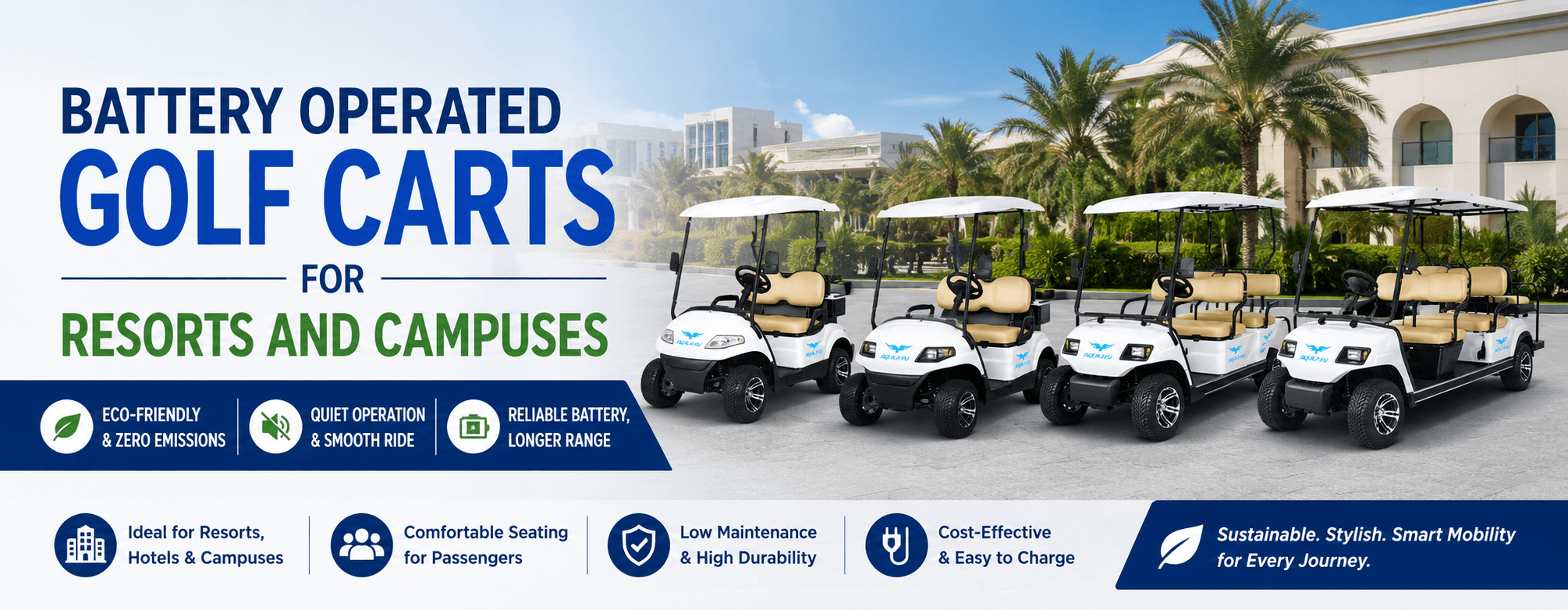
Battery operated golf carts are transforming the way resorts, campuses, and large facilities manage internal transportation. By switching from fuel-based shuttles to battery operated golf carts , businesses can significantly reduce costs, cut emissions, and improve guest and staff experience, all while staying compliant with evolving environmental norms.
What Are Battery Operated Golf Carts?
Battery operated golf carts are compact, electric-powered vehicles designed for short-distance, in-campus mobility. Instead of diesel or petrol, they run on rechargeable batteries, typically advanced lithium-ion batteries, that power a quiet, efficient electric motor.
Unlike traditional fuel-based buggies or vans, electric golf carts are:
- Purpose-built for in-campus transportation
- Designed for low-speed, safe mobility in people-dense environments
- Ideal for frequent stop-and-go operations across large properties
For resorts, university campuses, industrial parks, hospitals, tech parks, airports, and large institutions, these battery-powered golf carts serve as the backbone of day-to-day mobility, ensuring people and goods move smoothly, safely, and sustainably.
Why Resorts and Campuses Need Electric Mobility Solutions
Large properties face unique mobility challenges. As guest expectations rise and regulations around emissions tighten, relying solely on conventional internal transport comes with several pain points.
1. High Fuel Costs
Running diesel or petrol vans inside a property leads to:
- Constant fuel expenses
- Price volatility impacting annual budgets
- Higher per-trip operating costs compared to electric alternatives
2. Noise and Air Pollution
For hospitality and institutional environments, ambience and comfort are critical. Fuel vehicles generate engine noise, exhaust fumes, and vibrations that disturb guests, patients, students, and staff.
3. Increasing Maintenance Expenses
Combustion engines, gearboxes, and fuel systems require frequent servicing, oil changes, and part replacements, leading to higher downtime and recurring costs.
4. Inefficient Internal Transportation
Many properties still rely on ad-hoc transport solutions, individual cars, uncoordinated shuttles, or staff walking long distances. This results in:
- Delayed responses
- Longer transit times
- Poor experience for VIPs, guests, and visitors
5. Environmental Compliance Requirements
Governments, regulatory bodies, and corporate ESG goals are pushing for eco-friendly transportation vehicles with low or zero emissions, especially in campuses, industrial parks, and public-facing facilities.
6. Limited Mobility for Guests and Staff
Guests with luggage, elderly visitors, people with reduced mobility, and on-ground staff often struggle to move between distant points without a convenient, on-demand transport solution.
This combination of rising costs, operational inefficiencies, and compliance pressure is exactly why electric mobility solutions – especially battery operated golf carts – are becoming a strategic necessity for resorts and campuses.
Benefits of Battery Operated Golf Carts for Resorts and Campuses
Adopting battery operated golf carts directly addresses these pain points while unlocking multiple business benefits.
1. Significant Reduction in Operating Costs
Compared to fuel-based vehicles, battery-powered golf carts offer:
- Much lower energy cost per kilometre
- No fuel purchases, no engine oil, fewer consumables
- Reduced wear-and-tear due to simpler electric drivetrains
Over time, this translates into substantial savings and faster ROI, especially for properties that run multiple carts across long hours each day.
2. Eco-Friendly, Zero-Emission Transportation
As eco-friendly transportation vehicles, electric golf carts help:
- Achieve zero tailpipe emissions inside the campus
- Reduce the overall carbon footprint of your facility
- Support sustainability and ESG commitments
For resorts, universities, and corporate campuses that promote green initiatives, this becomes a powerful brand message as well.
3. Quiet and Comfortable Guest Experience
Electric golf carts operate almost silently. This is a critical advantage for:
- Premium resorts and hotels where peace and ambience matter
- Hospitals and healthcare campuses where noise must be minimized
- Educational institutions and temples where calm environments are essential
Guests and users enjoy smoother, quieter rides without the vibration or sound of combustion engines.
4. Low Maintenance, High Uptime
With high-quality lithium-ion batteries and robust electric drivetrains, these carts offer:
- Fewer moving parts compared to fuel vehicles
- Reduced servicing frequency
- Less unplanned downtime
Paired with a responsive service team and reliable manufacturing, property owners can ensure uninterrupted operations.
5. Enhanced Guest and Staff Mobility
Well-planned golf carts for resorts and campus golf carts can:
- Provide door-to-door transport for guests with luggage
- Shuttle visitors between lobbies, rooms, restaurants, pools, and activity zones
- Support staff movement between departments, hostels, blocks, and warehouses
- Improve movement in industrial parks and tech parks for supervisors and engineers
Result: Faster response times, higher guest satisfaction, and happier employees.
6. Better Compliance and Future-Readiness
With increasing focus on clean mobility, many agencies recommend or mandate electric options within campuses. Investing now in electric golf carts ensures:
- Long-term compliance with upcoming regulations
- Easier integration with smart, connected mobility systems
- Readiness for future expansions of your property
Key Features to Look For in Battery Operated Golf Carts
When choosing battery operated golf carts or electric utility carts for your property, focus on features that impact safety, durability, and total cost of ownership.
Here are key factors to evaluate:
1. Battery Technology
- Prefer lithium-ion batteries for longer life, faster charging, and improved performance.
- Check battery capacity and range per charge based on your route and usage patterns.
2. Build Quality and Durability
- Sturdy chassis and body suitable for daily, high-frequency use.
- Weather-resistant design for outdoor operations.
- High-quality suspension for comfort and stability on uneven internal roads.
3. Seating and Load Capacity
- 2, 4, 6, or 8-seater configurations based on guest volume.
- Dedicated luggage space for resorts and hotels.
- Flatbeds or cargo configurations for electric utility carts in industrial and commercial environments.
4. Safety and Comfort Features
- Powerful yet controlled braking systems.
- Headlights, indicators, horns, and mirrors for safe in-campus navigation.
- Comfortable seating, handrails, and easy ingress/egress for elderly and differently-abled passengers.
5. Service Support and Response Time
- Strong after-sales network with multiple service touchpoints.
- Assured response time (for example, within 48 hours).
- Availability of genuine spare parts and expert technicians.
6. Scalability and Deployment Capacity
- Manufacturer’s ability to deploy and support a larger fleet (e.g., 1000+ vehicles annually).
- Proven experience across different types of campuses, factories, temples, tech parks, airports, and resorts.
These features ensure that your investment in electric golf carts delivers long-term, reliable performance.
Applications Across Industries
Battery operated golf carts are no longer limited to golf courses. Today, they are widely deployed across various sectors as in-campus electric golf carts and utility electric vehicles.
Here are some high-impact use cases:
1. Resorts and Hotels
- Guest pick-up and drop from reception to rooms, villas, and suites
- Luggage transport across the property
- Shuttle services to restaurants, pools, spas, and activity areas
- Internal staff movement for housekeeping, maintenance, and F&B
Result: Smooth guest journeys, premium experience, and efficient operations.
2. University and College Campuses
- Student and faculty transport between departments, hostels, libraries, and labs
- Special support for differently-abled students or visitors
- Administrative staff mobility for inspections and events
- Campus tours for prospective students and parents
Result: Better accessibility, improved campus connectivity, and enhanced institutional image.
3. Corporate and Tech Parks
- Employee shuttles between office blocks, parking zones, cafeterias, and common facilities
- On-demand carts for VIP visitors and senior leadership
- Logistic support for internal courier and document movement
Result: Higher productivity, reduced travel fatigue, and modern, green campus positioning.
4. Hospitals and Healthcare Campuses
- Patient and attendant mobility across large hospital complexes
- Transport for medical staff between critical departments and accommodation blocks
- Quick shuttles for diagnostics, labs, and support services
Result: Better patient experience and more efficient healthcare operations.
5. Industrial Parks and Factories
- Supervisors and engineers moving quickly across large plants
- Electric utility carts transporting tools, spares, and light materials
- Safe and controlled movement even inside production environments
Result: Improved operational efficiency and safer internal logistics.
6. Temples, Airports, and Public Spaces
- Devotee transport in large temple complexes
- Passenger transport inside airports and railway stations
- Elderly and VIP mobility in large public venues
Result: Better crowd management, accessibility, and comfort in high-footfall spaces.
How to Choose the Right Golf Cart for Your Property?
For decision-makers like resort owners, hotel managers, campus administrators, and facility managers, selecting the right
battery operated golf carts requires a structured approach.
Consider the following steps:
1. Map Your Internal Routes and Usage Patterns
- Identify high-traffic routes: reception to rooms, hostel blocks, factory gates to production lines, etc.
- Estimate average trip frequency and load: number of passengers, luggage or cargo weight.
2. Define Your Fleet Size
- Start with core routes that demand frequent movement.
- Factor in peak time requirements, events, and seasonal spikes.
- Consider a mix of passenger and utility carts.
3. Choose the Right Configuration
- 4–6 seater carts for regular guest shuttles.
- 8-seater or extended carts for group movements.
- Utility carts for housekeeping, maintenance, and logistics.
4. Evaluate Total Cost of Ownership (TCO)
- Compare fuel costs vs. electricity costs.
- Assess maintenance needs, service intervals, and battery replacement cycles.
- Look at real-world case studies to estimate payback period and ROI.
5. Partner with an Experienced Manufacturer
Opt for a partner with:
- 10+ years of experience in manufacturing in-campus battery operated vehicles.
- Proven track record of deploying 1200+ vehicles across varied environments.
- Manufacturing capacity of 1000+ vehicles annually for scalability.
- Multiple service touchpoints and rapid response times.
An experienced manufacturer understands real-world operating conditions and can recommend the best mix of
campus golf carts and electric utility carts for your specific needs.
Future of Sustainable Campus Transportation
The future of internal mobility is undeniably electric. As sustainability, guest experience, and operational efficiency become core business drivers,
battery operated golf carts are set to play an even larger role in campus transportation strategies.
Some key trends shaping this future include:
- Wider adoption of lithium-ion powered golf carts for higher range and faster charging.
- Integration with fleet management and tracking systems for optimized usage.
- Advanced safety features and ergonomics to support all age groups and user segments.
- Greater focus on design, comfort, and brand customization for premium properties.
Resorts, universities, industrial parks, hospitals, and commercial campuses that proactively invest in
electric golf carts today will be better positioned to:
- Control long-term operational costs.
- Meet and exceed environmental compliance standards.
- Deliver superior guest and user experiences.
- Enhance their brand as forward-thinking, eco-conscious destinations.
Conclusion: Battery Operated Golf Carts as a Strategic Investment
For modern resorts, educational institutions, corporate campuses, hospitals, and industrial parks,
battery operated golf carts are no longer a luxury, they are a strategic mobility investment.
By replacing fuel-based internal transport with electric golf carts, properties can:
- Reduce fuel and maintenance costs.
- Eliminate internal noise and air pollution.
- Improve guest and staff mobility.
- Strengthen sustainability credentials.
- Achieve better ROI through efficient, low-cost operations.
Whether you manage a resort, a university campus, a tech park, or an industrial facility, now is the right time to evaluate how
battery powered golf carts, campus golf carts, and electric utility carts can transform your in-campus transportation into a sustainable,
efficient, and guest-friendly system.



 +91 91769 99900
 info@trielectric.in