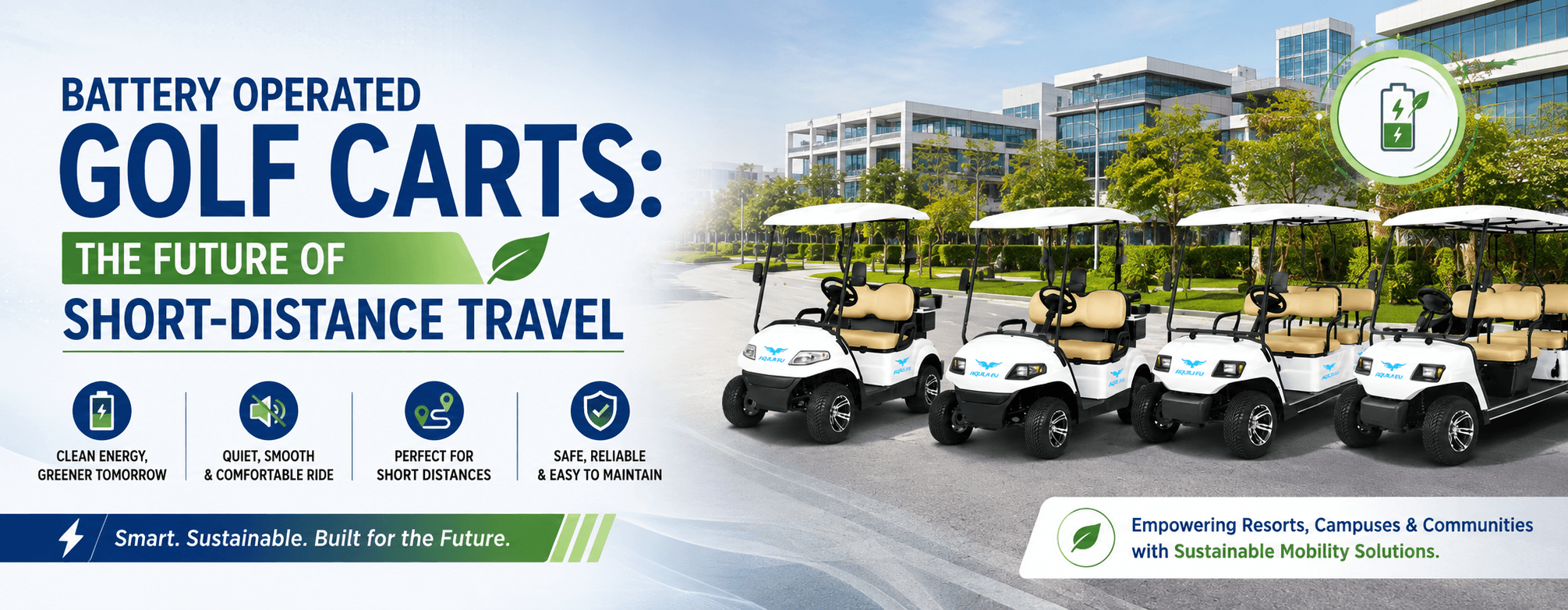
Short-distance mobility inside campuses, resorts, hospitals, factories, and gated communities is undergoing a major transformation. Battery operated golf carts are emerging as the smarter, cleaner, and more cost-effective alternative to traditional fuel-based vehicles, redefining how people and goods move over short distances in commercial and institutional environments.
From rising fuel prices to tightening environmental regulations, businesses today are under pressure to adopt eco-friendly transportation solutions that are both efficient and economical. In this context, electric golf carts and battery powered golf carts are rapidly becoming the go-to choice for modern campuses and facilities that want seamless internal mobility without noise, fumes, or high operating costs.
This blog explores why battery operated golf carts are the future of short-distance travel and how they are transforming mobility across resorts, hotels, educational institutions, hospitals, corporate campuses, industrial parks, and gated communities.
In large properties and campuses, short-distance travel is critical for guest experience, employee productivity, and operational efficiency. However, traditional solutions such as diesel jeeps, petrol cars, and shuttle buses come with significant challenges:
Facility managers and decision-makers are increasingly looking for alternatives that can solve these pain points without compromising on performance. This is where battery operated golf carts step in as an ideal solution.
Battery operated golf carts are compact, electric vehicles powered by rechargeable batteries, typically advanced lithium-ion batteries, designed for short-distance travel within controlled environments.
Originally used on golf courses, they have now expanded into a wide variety of applications, including:
Unlike conventional vehicles, battery powered golf carts are purpose-built as campus mobility vehicles, designed to transport people and goods quietly, efficiently, and sustainably.
Battery operated golf carts deliver value on three major fronts: cost savings, sustainability, and operational efficiency.
One of the biggest pain points for businesses is the continuous rise in fuel costs. Every liter of petrol or diesel consumed by conventional internal transport adds to operating expenditure.
With electric golf carts, the primary energy source is electricity, which is substantially cheaper than fuel in most regions. Key cost-related benefits include:
Over the lifespan of the vehicle, these factors translate into substantial savings, especially for resorts, corporate campuses, and industrial parks that operate multiple vehicles daily.
Sustainability is no longer optional; it is a core business requirement. Battery operated golf carts support green initiatives by providing:
For hotels, hospitals, educational institutions, and gated communities that want to be seen as responsible, environment-conscious brands, adopting eco-friendly transportation solutions like electric golf carts sends a strong message to guests, patients, students, and residents.
Noise pollution is a serious concern in hospitality, healthcare, and residential environments. Traditional vehicles with combustion engines generate sound that can disturb guests resting at a resort, patients recovering in a hospital, or residents in a gated community.
In contrast, battery powered golf carts offer:
This makes them ideal for luxury resorts, wellness retreats, spiritual centers, and educational campuses where ambience and tranquility are important.
Modern battery operated golf carts built using robust engineering standards and lithium-ion batteries are designed for long-term performance. Advantages include:
With manufacturing capacities reaching hundreds or thousands of vehicles annually, reputed manufacturers can support large deployments across multiple campuses and locations.
Battery powered golf carts today are not limited to just passenger transport. They are available as:
This versatility makes them valuable across different industries and property types.
Let us connect the features of battery operated golf carts directly to the key challenges faced by businesses and institutions.
To understand real-world impact, let’s look at how different segments can benefit from electric golf carts and electric utility vehicles.
For resort owners and hotel managers, guest experience is everything. Golf carts for resorts are widely used for:
Battery operated golf carts elevate the guest experience by combining convenience, comfort, and sustainability. Guests often associate quiet, clean vehicles with high-end hospitality standards.
Large schools, colleges, and universities often operate across vast campuses. Campus mobility vehicles solve multiple challenges:
Using battery operated golf carts demonstrates a commitment to innovation and sustainability, traits that parents and students increasingly value.
In healthcare, quiet, reliable mobility matters more than ever. Battery powered golf carts can be used for:
Their low noise and zero emissions make them well-suited for sensitive environments where patient comfort and air quality are important.
For corporate campuses and IT parks, electric golf carts become part of the company’s internal mobility strategy:
This not only improves productivity and convenience but also reinforces the company’s commitment to sustainability and modern infrastructure.
In industrial settings, internal transportation must be robust and efficient. Battery operated carts can:
By replacing traditional fuel vehicles with electric utility vehicles, industrial parks reduce emissions, running costs, and maintenance overhead.
Residents of gated communities expect safe, clean, and convenient mobility inside the premises. Battery powered golf carts provide:
They enhance lifestyle quality while supporting the community’s eco-friendly positioning.
The following table highlights how battery operated golf carts compare with conventional fuel-based internal transport:
| Feature / Factor | Battery Operated Golf Carts | Traditional Fuel Vehicles |
|---|---|---|
| Energy Source | Electricity (battery powered) | Petrol / Diesel |
| Operating Cost | Low per km, predictable | High, sensitive to fuel price fluctuations |
| Emissions | Zero tailpipe emissions, eco-friendly transportation | Significant emissions, air pollution |
| Noise Level | Very low, quiet mobility | High engine and exhaust noise |
| Maintenance | Low, fewer moving parts | High, complex engine and mechanical systems |
| Suitability for Campuses | Ideal for short-distance campus mobility vehicles | Often overpowered and noisy for internal use |
| Guest/Resident Comfort | Smooth, quiet, comfortable | Less comfortable due to noise and fumes |
| Regulatory Compliance | Aligns with green and low-emission norms | Increasingly restricted in many environments |
This comparison clearly shows why battery operated golf carts are being adopted as the preferred choice for short-distance travel.
Advancements in electric mobility and battery technology have transformed electric golf carts into highly efficient, future-ready vehicles. Some notable features include:
With manufacturing capacities capable of deploying hundreds or thousands of vehicles annually and strong after-sales support, modern manufacturers ensure that businesses and institutions can scale their internal mobility without compromise.
Looking ahead, several trends point to battery operated golf carts becoming the default choice for short-distance mobility in commercial, hospitality, healthcare, educational, and industrial environments:
Governments, businesses, and institutions are prioritizing low-emission transport options. Electric golf carts directly support these sustainability objectives.
As fuel and maintenance costs climb, organizations are compelled to adopt low-cost, high-efficiency alternatives. Battery powered solutions align perfectly with this need.
As more integrated townships, tech parks, industrial corridors, and destination resorts emerge, the demand for reliable campus mobility vehicles is only increasing.
Continuous improvements in battery technology and vehicle engineering are making electric golf carts even more powerful, durable, and economical.
Modern customers expect quiet, comfortable, and eco-friendly transportation within the spaces they live, work, learn, and relax. Battery operated golf carts deliver precisely that.
Together, these factors make battery operated golf carts not just a trend, but a long-term solution shaping the future of short-distance travel.
For resort owners, hotel managers, educational institutions, hospitals, corporate campuses, industrial parks, and gated communities, selecting the right electric golf carts and electric utility vehicles depends on:
Working with an experienced manufacturer of in-campus battery operated vehicles ensures access to:
Battery operated golf carts have evolved from simple golf course vehicles into strategic mobility assets for modern businesses and institutions. By offering eco-friendly transportation, lower operating costs, quiet performance, and versatile applications, they address critical pain points in short-distance travel.
For resorts, hotels, educational institutions, hospitals, corporate campuses, industrial parks, and gated communities, investing in battery operated golf carts and electric utility vehicles is not just a technology upgrade, it is a forward-looking decision that aligns with sustainability, guest satisfaction, and operational efficiency.
In an era where every organization is seeking smarter ways to move people and goods, battery operated golf carts truly represent the future of short-distance travel.



 +91 91769 99900
 info@trielectric.in