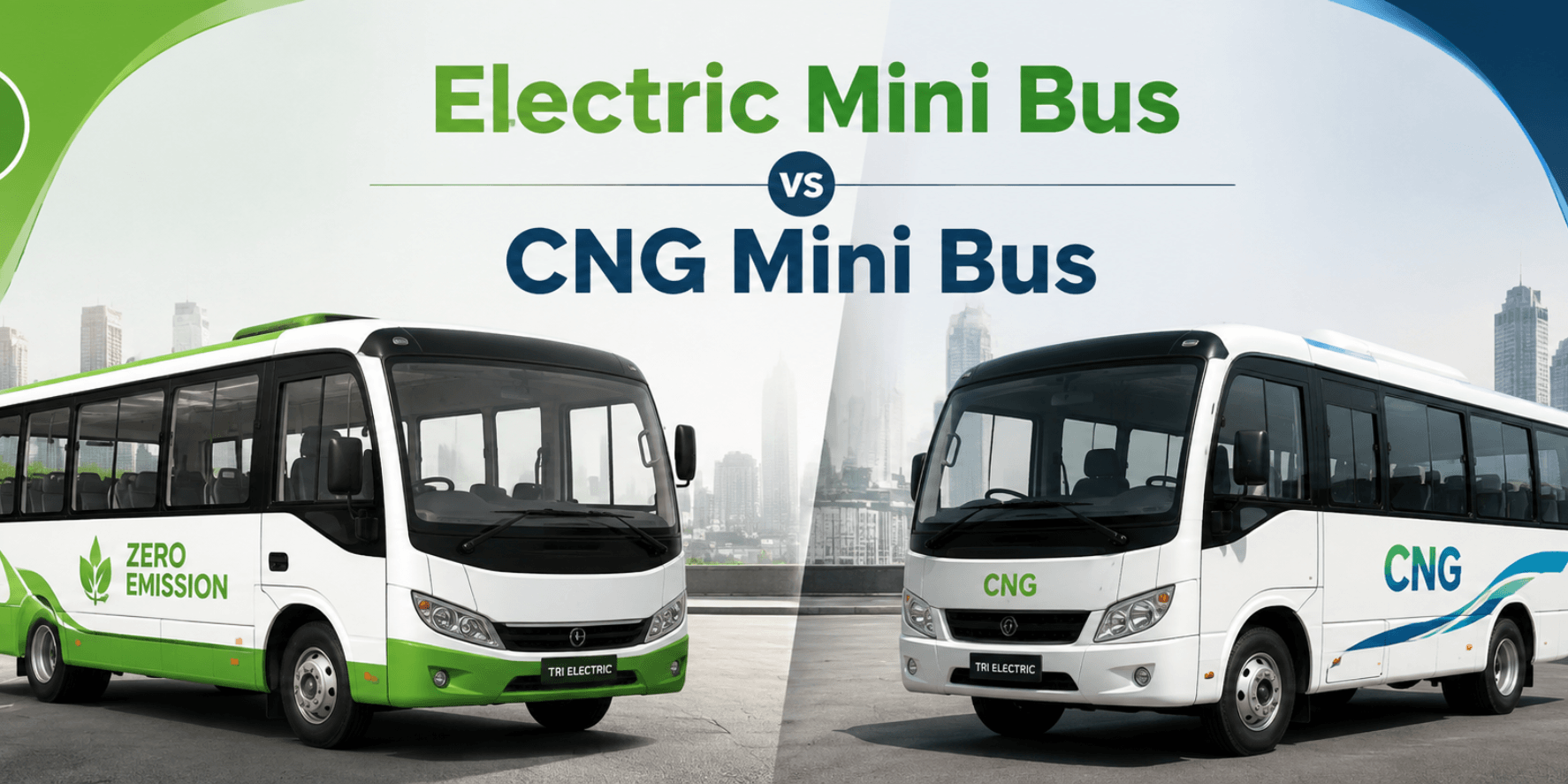
Commercial transportation in India is at a turning point. Fleet owners, school operators, corporate mobility providers, and public transport authorities are under pressure from rising fuel costs, stricter emission norms, and growing expectations for safer, greener mobility. In this context, choosing between an electric mini bus and a CNG mini bus has become a strategic business decision, not just a vehicle purchase.
This comparison helps operators make an informed decision based on cost, efficiency, sustainability, and long-term ROI. This detailed comparison of electric mini bus vs CNG mini bus is designed to help fleet owners and transport operators understand the key differences.
An electric mini bus is a compact commercial bus powered entirely by battery-electric drivetrains instead of diesel or CNG. It uses lithium-ion batteries to store energy and an electric motor to drive the wheels, resulting in zero tailpipe emissions and significantly lower operating noise.
For fleet operators, an EV mini bus is typically used for:
Key Characteristics of Commercial Electric Mini Buses
When manufactured by experienced players like Tri Electric Private Limited, electric mini buses benefit from over 10+ years of in-campus EV manufacturing expertise, robust product engineering, and responsive service support within 48 hours.
A CNG mini bus is a compact bus powered by an internal combustion engine (ICE) that runs on Compressed Natural Gas (CNG) instead of diesel or petrol. CNG is considered a cleaner fossil fuel, producing relatively lower emissions compared to diesel.
Common use cases for CNG mini buses include:
Key Characteristics of CNG Mini Buses
While CNG mini buses have helped reduce diesel dependence, they still rely on fossil fuels and are subject to fuel price volatility and evolving emission regulations.
Below is a high-level comparison to show how an electric mini bus and a CNG mini bus differ from a fleet owner’s perspective.
| Factor | Electric Mini Bus | CNG Mini Bus |
|---|---|---|
| Primary fuel/energy | Electricity (battery-powered) | Compressed Natural Gas (fossil fuel) |
| Tailpipe emissions | Zero | Lower than diesel, but not zero |
| Noise | Very low (near-silent operation) | Noticeable engine and exhaust noise |
| Running cost per km | Generally lower, especially off-peak tariffs | Higher and volatile, linked to CNG prices |
| Maintenance complexity | Lower, fewer moving parts | Higher, traditional engine + exhaust systems |
| Refuelling time | Charging takes longer than refuelling | Fast refuelling at CNG stations |
| Infrastructure dependency | Charging points, power availability | CNG stations network |
| Regulatory future | Strongly aligned with EV and clean mobility | Subject to stricter emission norms over time |
| Ideal route profile | Fixed routes, predictable daily run, campuses | Longer, variable routes with CNG access |
| Long-term ROI & TCO | Higher potential ROI with the right utilisation | Moderate ROI, dependent on fuel price trends |
One of the biggest pain points for transport operators is high upfront investment and ongoing operating costs. The choice between an electric mini bus and a CNG mini bus must therefore be viewed through Total Cost of Ownership (TCO), not just purchase price.
If budget is tight and you are focused purely on initial acquisition, a CNG mini bus appears more affordable. But this picture changes once you factor in fuel, maintenance, and regulatory risks.
For fleet owners doing structured daily operations, the electric mini bus can deliver predictable and lower energy costs, contributing to better cost control.
Total Cost of Ownership includes purchase price, financing, fuel/energy, maintenance, downtime, residual value, and regulatory compliance.
When evaluated over 5–10 years, many commercial fleets find that electric mini buses offer stronger TCO and ROI, especially in in-campus and fixed-route applications.
Range and performance are crucial for fleet operators dealing with route planning, schedule adherence and vehicle utilization.
From a passenger experience and driver comfort standpoint, EV mini buses hold a clear edge.
If your routes are fixed, predictable and under a certain daily km threshold, an electric mini bus is practical and efficient. For very long, variable routes with uncertain charging access, CNG mini buses still have an advantage.
Maintenance directly impacts downtime, fleet reliability, and operating margins.
Tri Electric’s in-campus EV solutions, for example, are supported by a service team with response time under 48 hours and 10+ service touchpoints across India. For fleet operators, this level of support reduces downtime and improves fleet availability.
Electric mini buses:
CNG mini buses:
Over several years, fleets typically observe:
From an operating cost perspective, commercial electric buses provide a compelling advantage for organizations focused on cost optimization and fleet efficiency.
Sustainability is no longer a “good to have”; it is a business requirement driven by regulations, corporate ESG commitments and public expectations.
For organizations operating inside tech parks, resorts, airports, factories, religious institutions or educational campuses, an electric mini bus aligns much better with sustainability and brand positioning.
Adopting sustainable transportation options such as electric mini buses today helps organizations stay ahead of regulations and secure long-term mobility continuity.
Fleet owners and transport operators often raise specific concerns when considering a commercial electric bus instead of a CNG mini bus. Let’s address them practically.
EV technology has matured significantly, and experienced manufacturers with 10+ years of in-campus EV deployment demonstrate stability and reliability. Partnering with such manufacturers reduces adoption risk and ensures compatibility with future upgrades.
For mini buses used in campuses, corporate parks, institutions or dedicated shuttle routes:
Unlike city-wide public transport, many commercial fleets operate fixed routes with defined start and end points, ideal for electric mini bus deployment.
Range anxiety is primarily a planning issue. When routes are:
Manufacturers can configure battery capacities to meet your specific needs. For in-campus and short-haul fleets, range is rarely a constraint when the solution is engineered correctly.
While EVs may have higher acquisition cost, the long-term savings in fuel and maintenance, combined with brand, ESG and regulatory benefits, often deliver better Return on Investment (ROI). When evaluated via TCO over 5–10 years, the electric mini bus frequently proves to be the more economical and strategic choice.
Electric Mini Bus vs CNG Mini Bus: A Detailed Comparison for Fleet Owners Electric Mini Bus vs CNG Mini Bus: A Detailed Comparison for Fleet Owners
In these scenarios, a commercial electric bus delivers strong TCO, better ROI, and future-ready fleet electrification.
Here, CNG mini buses can remain a bridge solution, especially in mixed fleets transitioning gradually toward electrification.
From a business lens, the decision is not simply electric mini bus vs CNG mini bus; it is about optimizing fleet efficiency, managing risk and maximizing long-term value.
For many modern fleets, the optimal strategy is to start electrifying high-potential routes first such as campus shuttles, short-haul employee transport and internal mobility, using EV mini buses from experienced manufacturers. This phased approach de-risks EV adoption while steadily improving TCO, fuel savings, and ESG performance.
By looking beyond the sticker price and focusing on Total Cost of Ownership, fleet electrification potential, and long-term regulatory trends, fleet owners and transport operators can confidently choose the right mini bus solution for their business and position their mobility operations for the future.



 +91 91769 99900
 info@trielectric.in