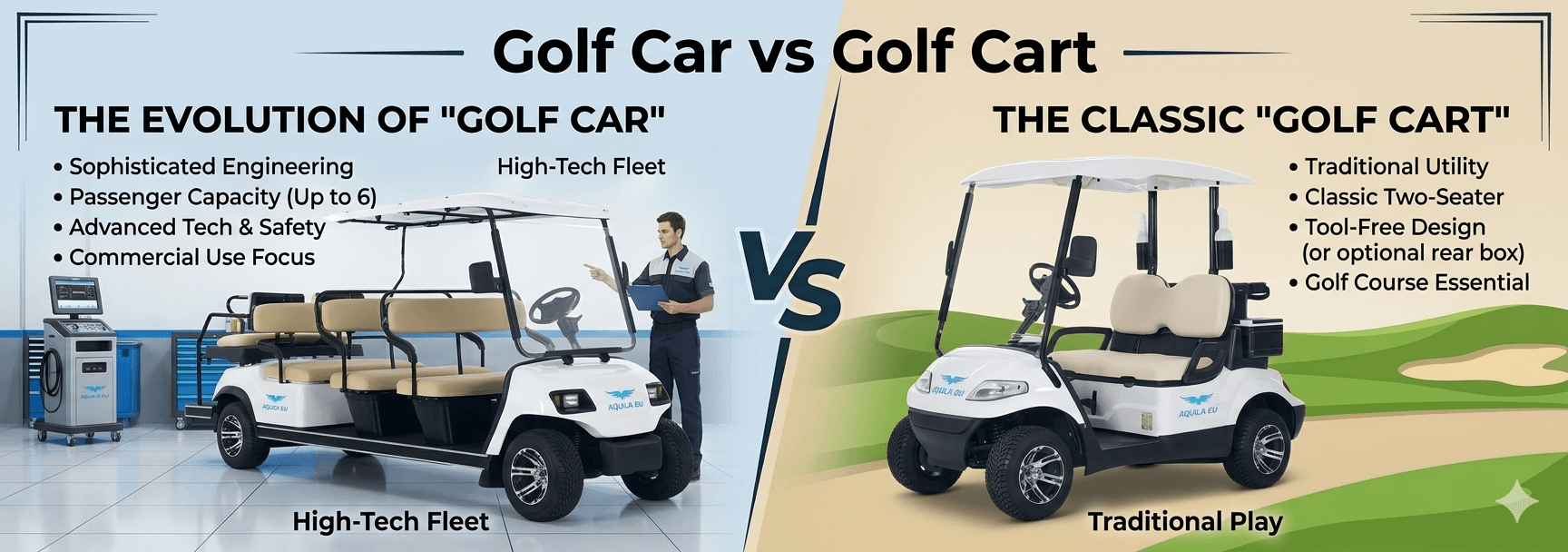
Are you confused about golf car vs golf cart ? Many buyers searching for eco-friendly vehicles for campuses, resorts, or gated communities mix up these terms, leading to wrong purchases. Understanding the difference helps you pick the right option for your needs, whether it's a simple golf cart for golf courses or a road legal golf car India for broader use. As India's top manufacturer of in-campus battery-operated vehicles like Tri Electric Private Limited, we clarify this to guide your golf cart buying guide .
A golf cart is a small, battery-powered vehicle designed mainly for short-distance transport on private property. It typically features a basic frame, 4-6 wheels, and low-speed motors.
Typical features include lithium-ion batteries for quiet operation, simple steering, and foldable seating for 2-4 passengers. These carts prioritize ease and affordability, with speeds capped at 20-25 km/h to suit controlled environments.
Common use cases focus on leisure and light utility. Golf courses use them to shuttle players without disturbing play. Resorts deploy electric golf cart for resorts to move guests between villas and pools. They're also popular in gated communities for quick neighborhood rides. Tri Electric, with over 10 years of experience, supplies these for campuses and tech parks, ensuring zero air pollution and reliable performance.
A golf car is a more advanced, often road-legal version of the golf cart, built for higher performance and versatility. It meets stricter safety standards, including lights, indicators, and reinforced chassis.
Technical differences stand out in power and build. Golf cars use stronger motors (up to 5-10 kW), advanced lithium-ion batteries for longer range (50-80 km per charge), and features like reverse alarms and hydraulic brakes. Many are road legal golf car India models, certified for public roads up to 25-40 km/h.
Road-legal characteristics make them suitable beyond private grounds. They include homologation for streets, number plate mounts, and compliance with Indian motor vehicle rules. At Tri Electric, established in 2014, our golf cars serve diverse clients from airports to factories with a service response under 48 hours and over 1200 vehicles delivered.
Here's a clear comparison to highlight golf car vs golf cart distinctions:
| Feature | Golf Cart | Golf Car |
|---|---|---|
| Speed | 20-25 km/h | 25-40 km/h |
| Power | 3-5 kW motor | 5-10 kW motor |
| Seating Capacity | 2-4 seats | 4-8+ seats |
| Road Legality | Private property only | Often road legal golf car India |
| Price | ₹2-5 lakhs | ₹4-10 lakhs |
| Use Cases | Golf courses, resorts | Gated communities, industrial, campuses |
These specs show golf carts as budget-friendly for basic needs, while golf cars offer durability for demanding tasks like golf cart for industrial use .
Choosing between golf car vs golf cart depends on your setting. Here's a buyer-friendly breakdown in your golf cart buying guide :
For resorts & golf courses : Go for an electric golf cart for resorts . Their low speed and quiet ride enhance guest experience without road needs. Tri Electric's models, with high-quality lithium-ion batteries, handle resort terrains smoothly.
For gated communities : Pick a golf car for gated communities . Road-legal options allow street access within compounds, offering more power for hills or longer routes. Ideal for resident shuttles.
For industrial transport : Choose a golf cart for industrial use or upgraded golf car. Robust builds carry goods in factories, with utility variants from Tri Electric supporting warehouses and tech parks.
For campuses & airports : Opt for golf cars with higher seating. They manage crowds efficiently, as seen in Tri Electric's deployments to railway stations and airports, with annual capacity over 1000 vehicles.
Consider your terrain, passenger load, and legal requirements to decide which is better golf cart or golf car .
Electric models from manufacturers like Tri Electric excel in long-term savings.
Purchase cost : Golf carts start at ₹2-5 lakhs, while golf cars range ₹4-10 lakhs due to advanced features.
Battery replacement : Lithium-ion batteries last 3-5 years (or 2000+ cycles), costing ₹50,000-1 lakh. Tri Electric's high-quality packs minimize downtime.
Operating cost : Just ₹0.50-1 per km on electricity vs ₹5+ for fuel vehicles. Maintenance is low, annual checks under ₹10,000 with Tri Electric's 10+ service touchpoints ensuring <48-hour response.
ROI : Payback in 1-2 years via fuel savings and 500+ happy customers like Tri Electric's. Eco-friendly choice cuts pollution for resorts or industries.
Standard golf carts aren't road legal, but many road legal golf car India models from Tri Electric are, with certifications for public use.
Yes, golf cars suit factories for golf cart for industrial use , handling goods and personnel efficiently.
With lithium-ion tech from Tri Electric, expect 3-5 years or 2000+ charge cycles under normal use.
Tri Electric Private Limited, India's finest in-campus battery-operated vehicle maker since 2014, offers tailored solutions. Contact us for your perfect golf cart or car.



 +91 91769 99900
 info@trielectric.in